
What Did Malcolm X Do? The Real Story Behind His Fight for Justice
Part of McDonald's Salutes the Faces of Black History, presented by the McDonald's NY Tri-State Owner/Operators. Digital campaign produced by 360WiSE MEDIA.
Malcolm X
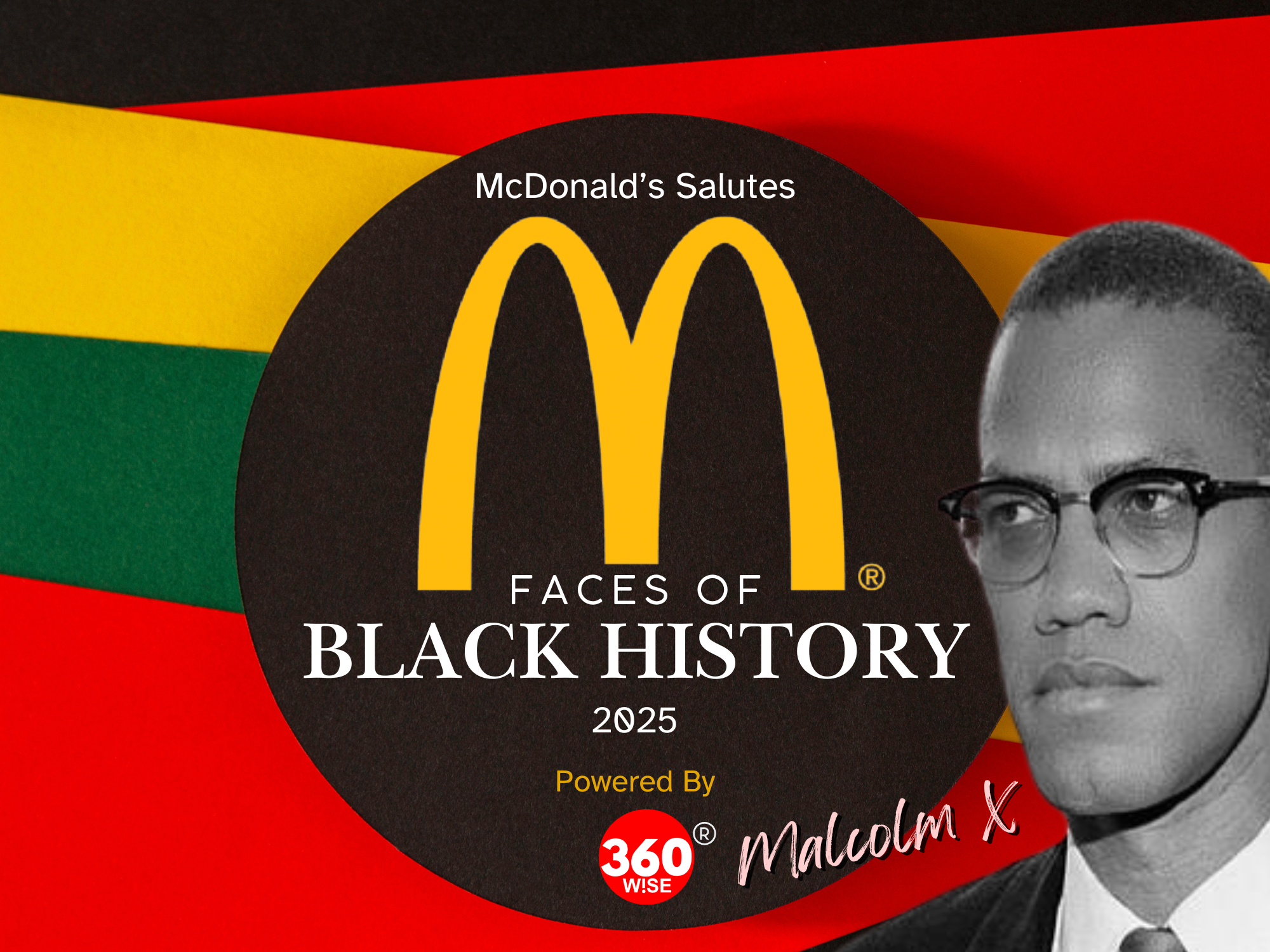
The story of Malcolm Little
Malcolm X’s leadership turned the Nation of Islam from a small religious group of 1,200 members into a powerful movement of up to 100,000 followers during the early 1960s. His message proved so potent that FBI surveillance tracked his every move from the 1950s until his assassination in 1965.
The story of Malcolm Little, born in 1925, stands as a testament to personal conviction and unwavering pursuit of justice. Prison walls could not contain his growing influence – there, his conversion to the Nation of Islam sparked a voice that would echo through generations. His bold stance on self-defense “by any means necessary” challenged the established civil rights narrative, offering a stark alternative to nonviolent resistance strategies.
Malcolm X’s legacy shaped the civil rights movement through raw honesty and fearless advocacy. His remarkable journey from early hardship to spiritual awakening reveals a leader whose vision evolved with his experiences. Today, his words and actions continue to inspire those who seek truth and justice, proving that one voice can indeed spark lasting change.
Early Life and Path to Activism
Family Background and Early Struggles
Earl Little, a Baptist minister and passionate follower of Marcus Garvey’s black nationalism, planted seeds of racial pride and self-reliance in his children’s hearts. The Little family’s story began in Omaha, Nebraska, where white supremacist threats forced them to seek safety first in Milwaukee, then in Lansing, Michigan.
Tragedy struck when flames consumed their home in 1929. The family’s world shattered further in 1931 with Earl Little’s death – officially deemed a streetcar accident. Their hardship deepened when the insurance company denied benefits, claiming suicide, leaving the family struggling for survival.
Louise Little’s strength carried her eight children through these dark times until the weight became too heavy to bear. 1939 marked another painful chapter as she entered Kalamazoo State Hospital, where she would spend the next 26 years.
Prison Transformation and Education
Malcolm’s life changed course at age 20 inside Charlestown State Prison walls. A fellow inmate called “Bimbi” opened his eyes to knowledge’s liberating power. His hunger for learning drove him to:
- Copy every word of the dictionary, strengthening both mind and penmanship
- Immerse himself in history, philosophy, and genetics through prison library books
- Sharpen his voice through prison debate team participation
Passion fueled his daily fifteen-hour reading sessions, with prison landing lights guiding his studies after hours. His mind soared through pages about Gandhi, African colonization, and rich black civilizations.
Conversion to Nation of Islam
Four of Malcolm’s siblings had found their path in Islam, sharing Elijah Muhammad’s teachings with their brother. The Nation of Islam’s message of self-determination echoed the principles his father had taught years before. Through letters with Elijah Muhammad, Malcolm embraced his new identity, casting off “Little” for “X” – a powerful rejection of his slave name.
1952 marked Malcolm X’s emergence from prison – a man reborn through faith and knowledge. Prison walls had shaped both his intellectual prowess and the powerful voice that would soon thunder through the civil rights movement.
Rise as a Civil Rights Leader
Building the Nation of Islam
Malcolm X’s magnetic leadership sparked remarkable growth within the Nation of Islam. His passionate dedication helped the movement soar from merely 400 members in 1952 to an impressive 40,000 members by 1960. His role as national representative brought new energy to the Northeast, where he built strong foundations through temples in Harlem (No. 7) and Philadelphia (No. 12).
Development of Leadership Style
Economic freedom stood at the heart of Malcolm X’s vision for Black communities. His call for “Economic Nationalism” pushed beyond rhetoric into action, nurturing NOI-owned businesses and local economic growth. “Our communities must become our own marketplace,” he declared, urging Black Americans to “control, own and operate the businesses of their community”.
His razor-sharp intellect and masterful speaking skills commanded attention in every debate about race, religion, and politics. Urban Black communities, especially in northern and western cities, found their frustrations voiced through his powerful words.
Key Speeches and Messages
Malcolm X’s speeches rang with truth and purpose, each word carefully chosen to awaken Black consciousness. His most powerful messages echoed through:
- “By Any Means Necessary” – a bold declaration of human dignity
- “Message to the Grass Roots” – a rallying cry for Black unity
- “The Ballot or the Bullet” – a blueprint for community power
His bold voice challenged comfortable assumptions about civil rights progress. He famously criticized the 1963 March on Washington as the “Farce on Washington”. His vision reached beyond American shores, building bridges with emerging African nations.
FBI Director J. Edgar Hoover felt so threatened by Malcolm’s growing influence that he ordered his New York office to “do something about Malcolm X”. Yet his message of pride and self-determination found eager listeners among young activists and students questioning traditional approaches to civil rights.
Revolutionary Approach to Civil Rights
Malcolm X stood as the bold voice of Black nationalism, challenging the gentle current of nonviolent resistance. His message rang clear – Black Americans held the right to protect themselves against racial violence.
Alternative to Nonviolent Resistance
“Teaching nonviolence to people facing daily brutality defies logic,” Malcolm X declared. His message about self-defense echoed through Black communities: protect your families, defend your homes, guard your dignity. His call for formation of rifle clubs responded to violent attacks in Birmingham, Plaquemine, Cambridge, and Danville.
Black Nationalism Philosophy
Black separatism and economic freedom formed the bedrock of Malcolm X’s vision. His sharp wit cut through integration rhetoric, famously comparing it to “coffee with a cracker”. His blueprint for Black nationalism rested on four pillars:
- Black-owned businesses creating economic strength
- Community control of local politics
- Pride in African cultural heritage
- Unified voice across racial and religious lines
Community Organization Methods
Spring 1964 marked Malcolm X’s bold step forward as he established two significant organizations – the Muslim Mosque, Inc. and the Organization of Afro-American Unity (OAAU). These platforms amplified his message: smart political organizing and freedom from compromised leadership.
While Dr. King walked the integration path, Malcolm X carved a different route toward Black freedom. His voice thundered against systemic racism, urging Black communities to build their economic strength and embrace their cultural identity.
His philosophy planted seeds that bloomed into the Black Power movement of the 1960s and 1970s. Pride, self-defense, and economic independence became rallying cries for future generations. The 1964 defeat of the Mississippi Freedom Democratic Party proved Malcolm right – many activists began questioning whether nonviolence alone could win their freedom.
Global Impact and International Work
Malcolm X’s voice echoed beyond American shores, weaving the civil rights movement into a worldwide human rights struggle. His global influence soared after leaving the Nation of Islam in 1964, building bridges with freedom fighters across Africa and the Middle East.
African Independence Movements
Africa’s emerging leaders found a kindred spirit in Malcolm X during his continental journey. His message united African American civil rights with African independence, revealing these struggles as branches of the same tree. His footsteps touched soil from Egypt, Ethiopia, Tanzania, Nigeria, Ghana, Guinea, Sudan, Senegal, Liberia, Algeria, and Morocco, each visit strengthening bonds between peoples fighting for dignity.
International Human Rights Advocacy
Malcolm X’s brilliant strategic vision lifted the African American struggle from civil rights to human rights. This powerful shift opened doors at the United Nations, expanding support worldwide. His words still ring true: “On the level of human rights, we have the support of billions of Black, Brown, Red and Yellow people from all over this Earth behind us”.
His diplomatic skills shone when he secured pledges from eight African nations to bring Black America’s case before the United Nations as a human rights issue. His research drew wisdom from earlier champions – the National Negro Congress (NNC), NAACP, and Civil Rights Congress (CRC) – who had walked the UN halls before.
Building Global Alliances
Malcolm X wove a tapestry of global solidarity through:
- Bonds with Palestinian, Cuban, and Chinese freedom fighters
- Partnerships with African liberation leaders
- Deep connections with Middle Eastern leaders who saw him as America’s rising Islamic voice
His holy pilgrimage to Mecca deepened his resolve against neocolonialism. The Organization of Afro-American Unity (OAAU) became his platform to unite struggles against racial oppression worldwide. His vision crossed borders and faiths, understanding that true freedom requires unity.
Today’s global justice movements carry Malcolm X’s torch forward, his words about colonialism and empire still lighting the way. His gift for connecting local struggles with worldwide movements created a blueprint for human rights advocacy that continues to guide activists seeking justice across borders.
Evolution of Political Philosophy
March 1964 marked a watershed moment in Malcolm X’s journey in March 1964 as he stepped away from the Nation of Islam. His suspension by Elijah Muhammad, triggered by his comments on President Kennedy’s assassination, sparked a spiritual and philosophical awakening.
Split from Nation of Islam
Malcolm X’s eyes opened to the NOI’s boundaries as his vision expanded beyond its walls. The movement felt “too narrowly sectarian and too inhibited” to embrace the full scope of civil rights struggles. His new path led to founding the Muslim Mosque Inc., where political activism bloomed alongside spiritual growth. When he reached out to support civil rights efforts in Plaquemines Parish, Louisiana—breaking free from NOI restrictions—his expanded vision took flight.
Transformation After Mecca
Sacred sands of Mecca reshaped Malcolm X’s worldview during his pilgrimage to Mecca in April 1964. Saudi Arabia’s holy ground washed away his previous beliefs about racial division. His heart opened to “sincere hospitality and overwhelming spirit of true brotherhood” among believers of every race. This spiritual awakening dissolved his former views on racial separation, birthing a new understanding of human unity.
Final Vision for Racial Justice
Malcolm X’s wisdom deepened into a message that embraced all seeking justice. His mature vision rested on four pillars:
- Human rights as the foundation of all rights
- Wholehearted support for voter power, “one thousand percent”
- Unity with civil rights groups while keeping a warrior’s spirit
- Worldwide solidarity through the Organization of Afro-American Unity
His evolved spirit saw beyond simple questions of integration or separation—human dignity stood supreme. Previous certainties about black nationalism softened as he welcomed allies from all walks. His voice rang clear at a Congress of Racial Equality gathering: “We want freedom now, but we’re not going to get it saying ‘We Shall Overcome’”.
Malcolm X’s journey from separatist to global humanitarian painted a portrait of genuine growth. January 1965 found him wielding a deeper understanding of freedom’s path, knowing real change demanded both political muscle and united hearts. His assassination in February 1965 silenced his voice but could not dim his light—a beacon showing how wisdom grows when truth leads the way.
Conclusion
Prison walls could not contain Malcolm X’s spirit – they merely shaped the leader who would shake America’s conscience. His bold voice challenged comfortable civil rights approaches while lifting Black struggles from American streets to world stages.
February 1965 silenced his voice but amplified his message. Only 39 years walked this earth, yet his footprints mark every path toward justice. Black pride bloomed under his care, self-determination grew strong in his light, and human dignity found its warrior. Modern movements still draw strength from his example – militant yet open to alliance, unwavering yet willing to grow.
Malcolm X’s words echo through time, each speech and writing a testament to truth’s power. His remarkable journey from separation to unity proves that growth strengthens rather than weakens conviction. His greatest gift lives on – showing us how local struggles for justice belong to all humanity. Today’s freedom fighters carry his torch forward, proving that courage paired with wisdom lights the way toward true equality.
References
[1] – https://en.wikipedia.org/wiki/Malcolm_X
[2] – https://www.pbs.org/wgbh/americanexperience/features/malcolmx-timeline-malcolm-xs-life/
[3] – https://infed.org/mobi/malcolm-x-on-education/
[4] – http://web-static.nypl.org/exhibitions/malcolmx/becoming.html
[5] – https://www.britannica.com/question/When-did-Malcolm-X-convert-to-Islam
[7] – https://collaborativehistory.gse.upenn.edu/stories/malcolm-x-part-iii-malcolm-x-and-nation-islam
[8] – https://theconversation.com/the-nation-of-islam-a-brief-history-198227
[9] – https://newsone.com/3903093/malcolm-x-most-iconic-speeches/
[10] – https://researchcentre.trtworld.com/featured/malcolm-x-the-legacy-of-a-civil-rights-leader/
[11] – https://www.history.com/topics/black-history/malcolm-x
[12] – https://kinginstitute.stanford.edu/malcolm-x
[13] – https://teachingamericanhistory.org/blog/malcolm-x-rejects-nonviolent-strategy/
[14] – https://www.pbs.org/wgbh/americanexperience/features/malcolmx-and-civil-rights-movement/
[15] – https://www.mpac.org/article/malcolm-x-unity-solidarity-and-liberation/
[16] – https://www.hilbert.edu/social-justice-activists/malcolm-x
[17] – https://edsitement.neh.gov/closer-readings/malcolm-x-radical-vision-civil-rights
[19] – https://kinginstitute.stanford.edu/black-nationalism
[21] – https://amsterdamnews.com/news/2022/05/18/malcolm-x-and-his-plight-for-human-rights/
[22] – https://hoodcommunist.org/2021/12/09/peoples-centered-human-rights-malcolm-x/
[23] – https://crossculturalsolidarity.com/the-international-malcolm-x/
[25] – http://web-static.nypl.org/exhibitions/malcolmx/malcolm.html
[26] – https://aboutislam.net/shariah/refine-your-heart/born-again/malcolm-x-transforming-power-hajj/
[27] – https://www.thoughtco.com/malcom-x-in-mecca-2353496
[29] – https://www.britannica.com/biography/Malcolm-X

QUICK FACTS
-
How did Malcolm X’s philosophy evolve throughout his life? Malcolm X’s philosophy underwent significant changes, particularly after his pilgrimage to Mecca in 1964. He shifted from advocating strict racial separation to embracing the possibility of cross-racial alliances and a more inclusive approach to achieving racial justice. His final vision focused on human rights rather than just civil rights, and he began to support voter registration efforts while maintaining a militant stance.
-
What were Malcolm X’s key contributions to the civil rights movement? Malcolm X made several important contributions to the civil rights movement. He transformed the Nation of Islam into a powerful organization, advocated for Black pride and self-determination, and challenged the mainstream nonviolent approach. He also internationalized the struggle by connecting it to global human rights issues and building alliances with African independence movements.
-
How did Malcolm X’s approach differ from other civil rights leaders? Unlike leaders who advocated for nonviolent resistance, Malcolm X promoted self-defense “by any means necessary.” He emphasized Black nationalism, economic independence, and community empowerment. His approach focused on building Black-owned businesses, promoting cultural pride, and encouraging political control within Black communities.
-
What impact did Malcolm X’s international work have on the civil rights movement? Malcolm X’s international work significantly broadened the scope of the civil rights movement. He forged connections with African independence leaders, advocated for reframing the struggle as a human rights issue at the United Nations, and built global alliances. This approach helped gain international support for the movement and connected local struggles with global resistance against oppression
-
How did Malcolm X’s prison experience shape his activism? Malcolm X’s time in prison was transformative. He used this period for extensive self-education, reading widely and improving his oratory skills. It was also during his imprisonment that he was introduced to and converted to the Nation of Islam. This experience laid the foundation for his future activism, equipping him with knowledge and rhetorical abilities that would define his role in the civil rights movement.
Thank you to the New York Tristate Owner and Operators Association for your continued support.
Duke Ellington Facts: The Untold Story of America’s Jazz MasterRosa Parks: Beyond the Bus Boycott That Changed AmericaLeontyne Price Birthday Special: The Untold Story of America’s First Opera QueenThe Untold Story: What George Washington Carver Was Really Famous For [Beyond Peanuts]The Untold Story of Ralph Carter: From Good Times to Broadway SuccessWhat Did Martin Luther King Do? The Untold Story Behind His Greatest AchievementsWhat Did Malcolm X Do? The Real Story Behind His Fight for JusticeJackie Robinson’s Accomplishments: Baseball’s Bravest PioneerMuhammad Ali: His Most Famous FightEmmy-Winner Brenda Blackmon Receives Lifetime Achievement HonorThe Untold Story: How Jack Johnson Became the First Black Heavyweight ChampionWilma Rudolph Biography: From Polio Survivor to Olympic Legend (1960-2023)Who Was Elijah McCoy? The True Story Behind “The Real McCoy” InventionJesse Owens’ Olympic Medals: The Untold Story Behind His Gold RushShirley Chisholm: The Untold Story of America’s Political Pioneer
Archive note: Originally published on 360wise.com on February 1, 2025 by Robert Alexander, as part of McDonald’s Faces of Black History campaign produced by 360WiSE MEDIA. Third-party names, marks and images belong to their respective owners. This archive documents past campaign work and does not imply sponsorship or endorsement of current 360WiSE® services.